Mountain Building.
The forces that lift the landscape.
More than one way up.
Choose a process. Watch the transformation unfold, or jump between its stages.
Layers lie flat
A stack of rock layers begins relatively flat.
Interactive schematic · distances and time are not to scale.
How do mountains form?
Mountains don't form one single way — the process (called orogeny) takes several distinct forms, and the type of mountain you're looking at tells you which tectonic process built it.
Fold mountains
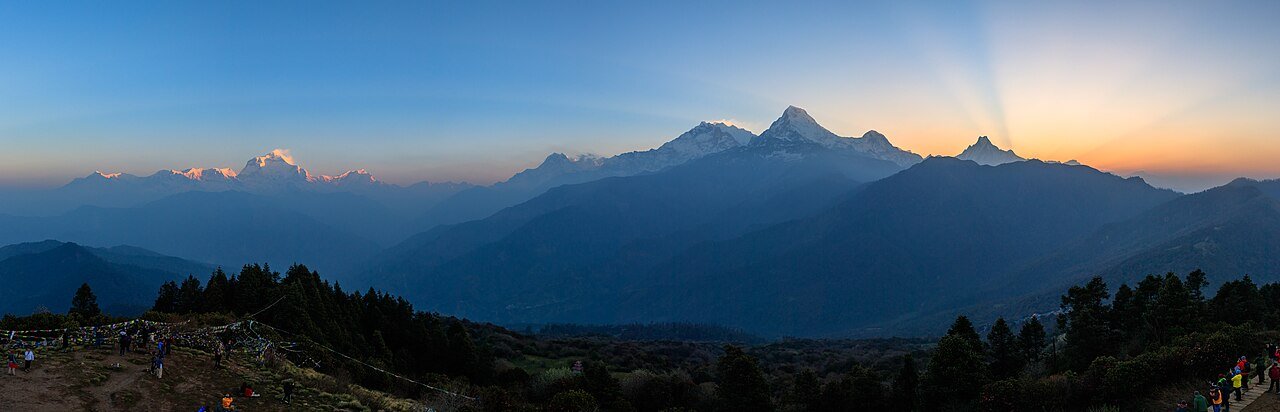
form when two plates collide and neither one subducts — typically two continental plates, which are both too light/buoyant to be forced underneath the other. With nowhere to go, the crust between them crumples and folds upward, like pushing a rug from both ends. This produces some of the tallest mountain ranges on Earth. The Himalayas are the textbook example, still actively rising today as the Indian plate continues driving into Asia — a collision that's been ongoing for roughly 50 million years and shows no sign of stopping.
Fault-block mountains
form when tectonic stress fractures the crust into large blocks, which then shift vertically relative to each other along those fractures (faults) — some blocks pushed up, others dropped down. This produces mountains with a distinctive steep, angular face on one side. The Sierra Nevada in California is a classic fault-block range.
Volcanic mountains
form through an entirely different mechanism — not folding or faulting, but the accumulation of erupted material (lava, ash) building up around a vent over repeated eruptions. Mount Rainier, Mount Fuji, and most individually-recognizable "mountain-shaped" volcanoes worldwide are built this way. (See the Volcanism page for how the type of eruption shapes the resulting mountain.)
Dome mountains
form when rising magma pushes up the crust above it without ever breaking through to erupt at the surface — creating a broad, dome-shaped bulge. Over time, erosion can wear away the softer overlying rock, eventually exposing the hardened magma body itself. The Black Hills of South Dakota formed this way.
A mountain is never finished the moment it's built
From the instant a mountain begins rising, weathering and erosion start working against it — wind, water, ice, and temperature change breaking the rock down and carrying it away. A mountain's height at any given moment is really the balance between how fast tectonic forces are pushing it up and how fast erosion is wearing it down. Young, actively-colliding ranges like the Himalayas are still winning that fight; old, tectonically-quiet ranges like the Appalachians — once possibly as tall as the Himalayas, hundreds of millions of years ago — have been worn down by erosion for so long they're now comparatively low, rounded, and soft-edged. The shape of a mountain range is basically a snapshot of who's currently ahead in that fight.